Paul Sharits
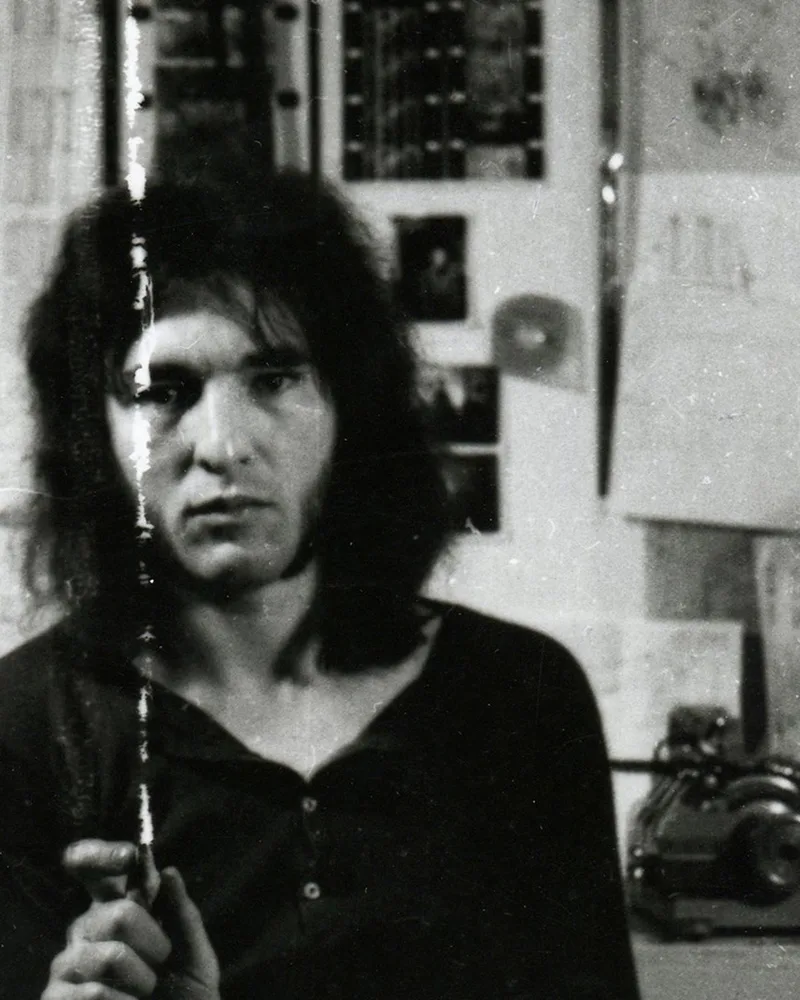
- 1966Ray Gun Virus
- 1968N:O:T:H:I:N:G
- 1968T,O,U,C,H,I,N,G
He composed films frame by frame on graph paper in coloured ink, then flashed solid colours at audiences until the screen seemed to pulse.
Sharits studied painting at the University of Denver, where Stan Brakhage took him under his wing, and then visual design at Indiana University in Bloomington. After his mother's suicide in 1965, most of his early narrative films were destroyed.
Ray Gun Virus (1966) was his first colour flicker film: fourteen minutes of single frames of solid colour and no images at all. The same year he made Word Movie for the Fluxus Fluxfilms series. N:O:T:H:I:N:G and T,O,U,C,H,I,N,G followed in 1968, and he planned every frame in advance on graph paper.
He taught at Antioch College, where Tony Conrad later took over his post, and from 1973 for almost twenty years in the Media Study department at the University at Buffalo. From 1971 he moved his work into galleries as 'locational' pieces, including Shutter Interface (1975), which runs on four projectors at once. He was shot in the stomach in a Buffalo bar in the late 1980s, which he put down to mistaken identity, and died in Buffalo in 1993, aged 50.
Where to start with Paul Sharits, in the order they were made. Runtimes are approximate.
Single frames of solid colour flicker for fourteen minutes, and no image ever appears. It was his first colour flicker film, and in his own notes Sharits cast the projector as a pistol.
Colour flicker broken up by a few simple images, laid out after the Tibetan mandala of the Five Dhyani Buddhas. P. Adams Sitney counted it, with Arnulf Rainer and The Flicker, among the three key flicker films.
Still images of the poet David Franks flash between frames of solid colour while a voice says one word, 'destroy', for the whole film, until it starts to sound like other words. Anthology Film Archives preserved it.
Footage of two volunteer patients from a medical study of seizures, reworked on an optical printer and cut with bursts of pure colour. The sound was made on computers at Carnegie Mellon University.